Physical Address
304 North Cardinal St.
Dorchester Center, MA 02124
Physical Address
304 North Cardinal St.
Dorchester Center, MA 02124

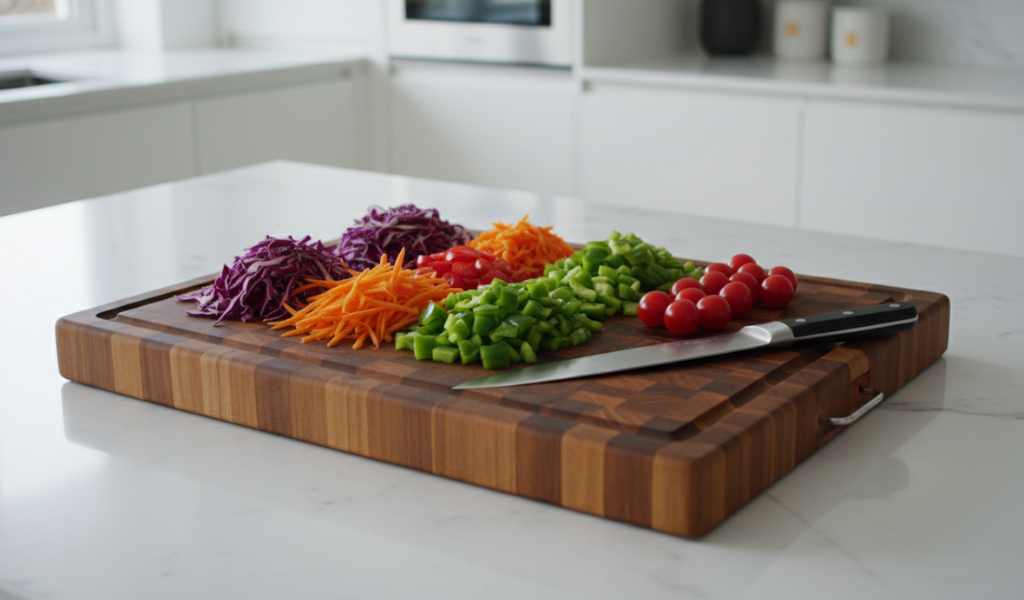
Preparing a meal should be a therapeutic experience, a way to connect with the ingredients that nourish your body. However, for many home cooks, the chopping block is a source of anxiety. Whether it’s a slippery tomato or a stubborn butternut squash, the risk of a slip-up is real. Learning how to cut fresh fruits & veggies safely is more than just a culinary skill; it is a fundamental safety requirement for anyone who steps into a kitchen. It also helps improve overall knife safety techniques and makes meal preparation faster and more efficient.
In this comprehensive guide, we will dive deep into the mechanics of knife work. We’ll explore the science of blade edges, the ergonomics of a proper grip, and the specific strategies required to handle the diverse textures of fruits and veggies. By the end of this article, you won’t just be “getting through” meal prep—you’ll be approaching it with the confidence of a professional chef.
To master how to cut fresh fruits & veggies safely, you must first understand the tool in your hand. A knife is not a monolithic piece of metal; it is a carefully engineered instrument designed for specific physical interactions.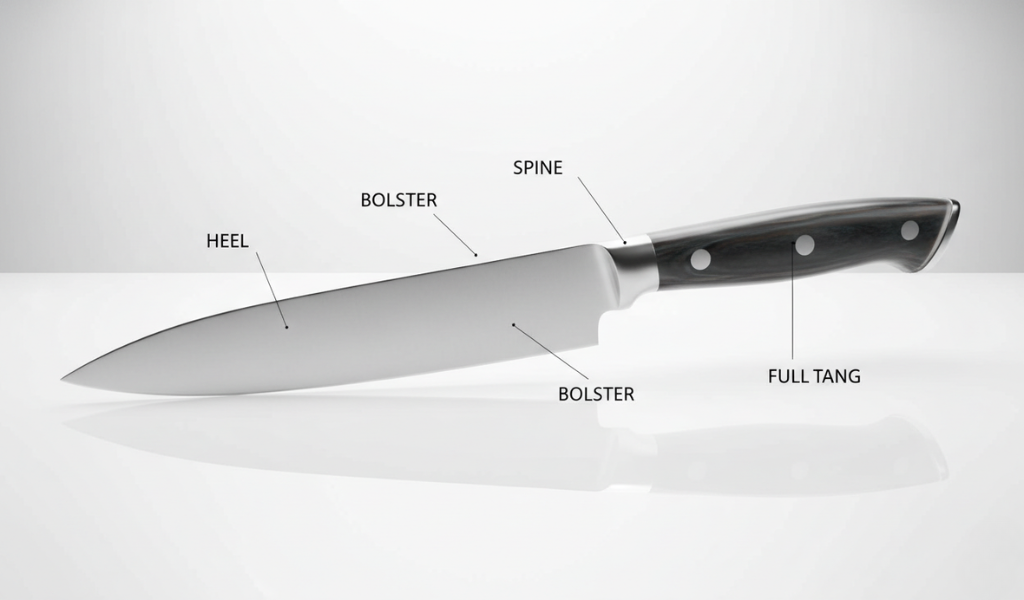
The blade is the heart of the knife. Most high-quality knives are made from high-carbon stainless steel, which offers a balance between edge retention (how long it stays sharp) and ease of maintenance (resistance to rust).
The bolster is the thick metal transition between the blade and the handle. It acts as a safety guard, preventing your hand from slipping onto the blade. The tang is the portion of the metal that extends into the handle. A ‘’full tang’’ knife is essential for safety because it ensures the knife won’t snap at the handle when you are putting pressure on a hard vegetable.
Not all knives are created equal. When considering how to choose the right knife, you must think about the scale of your hands and the types of fresh fruits you eat most often.
The Western Chef’s knife features a curved blade designed for a “rocking” motion. This is excellent for mincing herbs and dicing onions. The Santoku, on the other hand, has a flatter edge and is designed for a “push-cut” motion (straight up and down). Many home cooks find the Santoku easier to control because it is usually lighter and shorter, making it less intimidating for beginners.
While a chef’s knife does most of the heavy lifting, you need specialists:
Before a knife even touches a vegetable, your environment must be set up correctly. A sliding cutting board is the leading cause of finger nicks.
Avoid glass, ceramic, or marble cutting boards. They are incredibly hard and will roll the edge of your knife, making it dull after just one use. Wood or bamboo boards are the gold standard—they have a natural “grip” that holds fruits and veggies in place. High-quality plastic (polyethylene) is also acceptable and easier to sanitize.
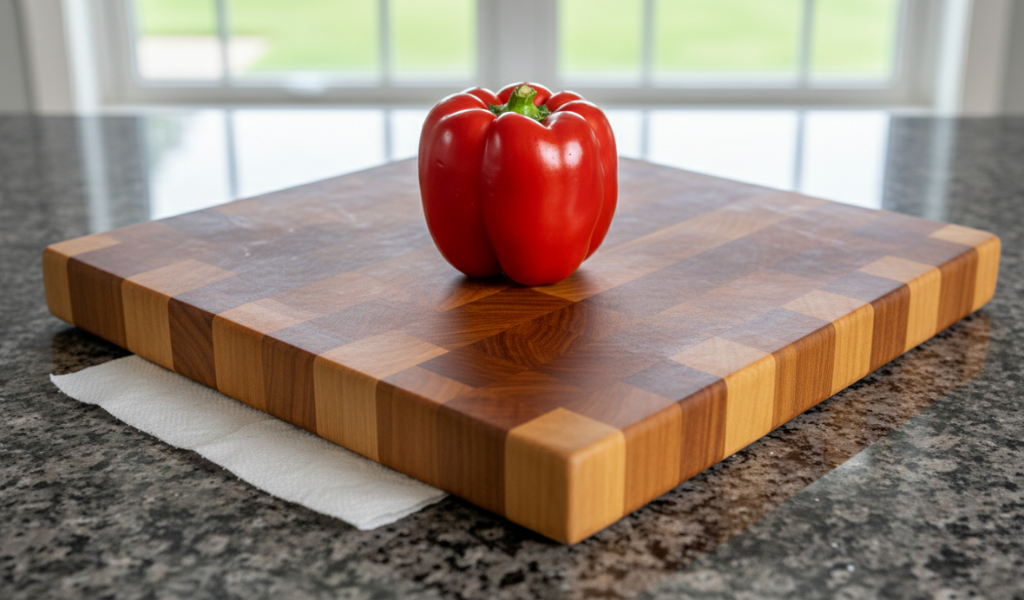
If your board doesn’t have rubber feet, it will slide on your countertop. To fix this, dampen a paper towel or a thin kitchen cloth and lay it flat under the board. This creates a suction effect that keeps the board ‘’anchored to the counter.’’ Never skip this step; a stable base is the first rule of how to cut fresh fruits & veggies safely.
Most people hold a knife by the handle alone. While this feels intuitive, it lacks stability. Professional chefs use the Pinch Grip.
These knife safety techniques are essential when learning how to cut vegetables and fruits safely without risking injury. This prevents the blade from twisting sideways a common cause of accidents when cutting through round veggies like carrots. Mastering how to hold a knife properly is one of the most important steps in learning how to cut fresh fruits & veggies safely.
Your dominant hand holds the power, but your non-dominant hand provides the guidance. This is where most injuries occur, so mastering these two positions is non-negotiable.
This is the most famous safety technique. You curl your fingertips under, resting your knuckles against the flat side of the blade. As the knife moves, your knuckles act as a buffer, keeping your sensitive fingertips safely tucked away.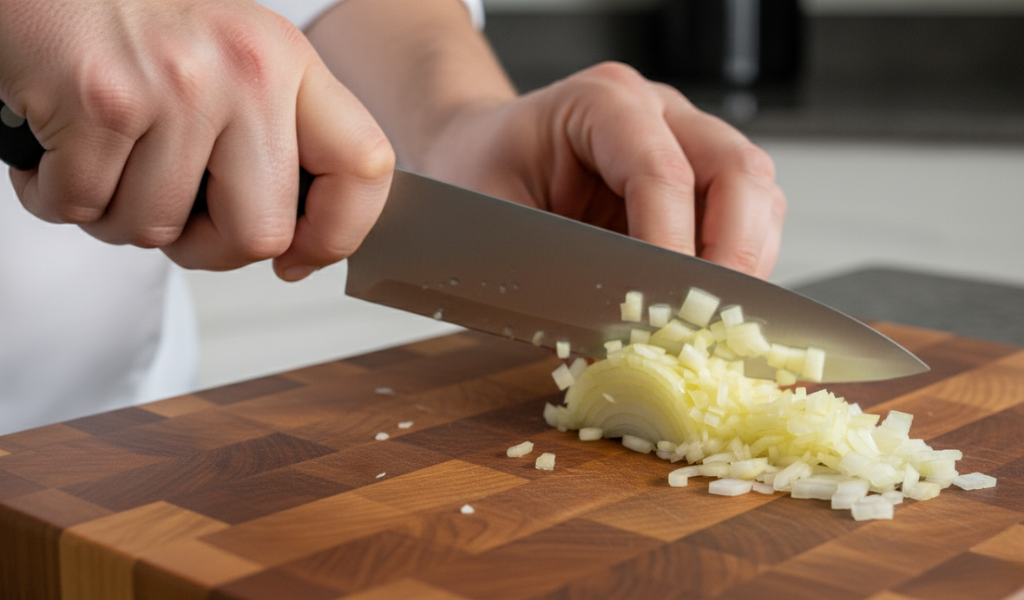
When you need to cut a round fruit in half (like a lime or a plum), use the Bridge. Form a bridge with your hand over the fruit, holding it with your thumb on one side and your fingers on the other. Slide the knife under the “bridge” and cut downward. This keeps your fingers completely out of the path of the blade.
Let’s apply these theories to actual production. The golden rule is: Create a flat surface.
Take a potato, for example. It wants to roll. If you try to slice it while it’s rolling, the knife will slip.
Fresh fruits like mangoes or peaches have large pits and slippery flesh. For a mango, cut off the two “cheeks” by sliding the knife along the flat side of the pit. Then, use a paring knife to score the flesh in a grid pattern—but do this while the mango is on the board, not in your hand!
These methods make cutting vegetables safely much easier, especially for beginners working with different textures.
Once you are comfortable with basic safety, you can move on to techniques that make your food look professional and cook evenly.
To julienne veggies like bell peppers or zucchini:
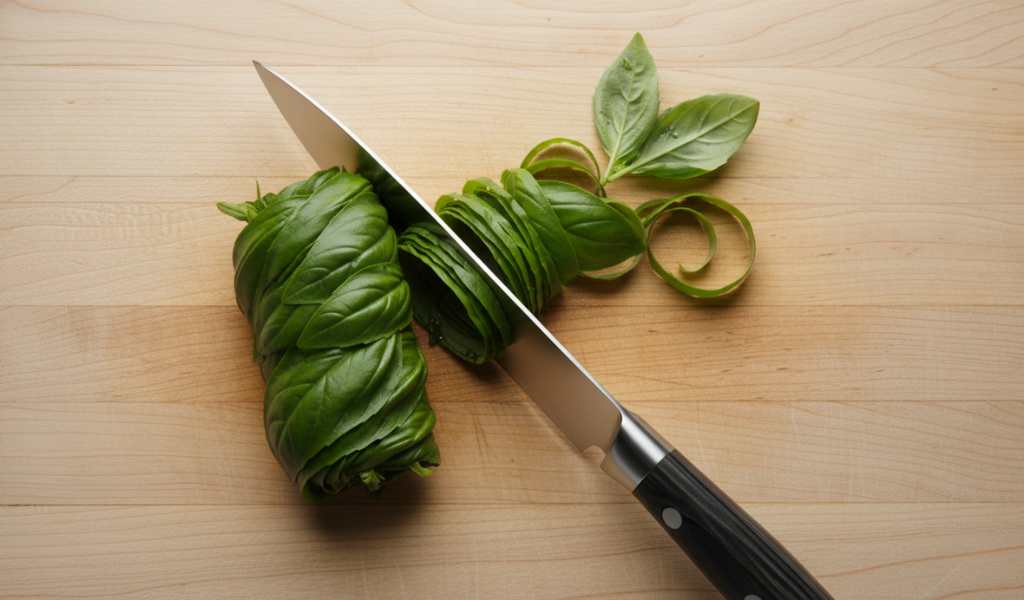
This is used for leafy herbs like basil or greens like spinach.
For garlic or parsley, pile the ingredients in the center of the board. Place your non-dominant hand flat on the spine of the knife near the tip. Keep the tip on the board and rock the handle up and down, moving the knife in a fan shape over the pile. This is the fastest way to mince while keeping your fingers ‘’completely out of danger.’’
Large produce requires a different strategy. You aren’t just cutting; you are managing mass and resistance.
A watermelon is heavy and round—a dangerous combination.
Squash is notoriously dense. If your knife gets stuck halfway through, do not try to yank it out. Instead, gently rock the knife back and forth while applying downward pressure with your palm on the spine of the blade. For very hard veggies, you can even use a vegetable peeler to remove the skin first, which reduces the friction on the knife.
You can follow every safety rule in the book, but if your knife is dull, you are still at risk. A dull blade requires more force, and force leads to lack of control.
Never, under any circumstances, put your professional knives in the dishwasher. The heat can ruin the temper of the steel, and the jostling can chip the edge. Hand wash with warm soapy water, dry immediately, and store in a knife block or on a magnetic strip. Storing knives loose in a drawer is a recipe for a cut finger when you reach in to grab a spoon.
Safety is as much about your mind as it is about your hands.
Mastering how to cut fresh fruits & veggies safely is a journey, not a destination. It starts with the right equipment knowing how to choose the right knife and how to maintain it. With consistent practice, these safety techniques quickly become natural habits that improve both speed and confidence in the kitchen. It continues with the physical techniques of the Pinch Grip and the Claw Position. Finally, it culminates in the habit of creating flat, stable surfaces for everything you prep.
As you practice these skills, you’ll find that your speed increases naturally. More importantly, your enjoyment of cooking will grow as the “chore” of chopping becomes a rhythmic, satisfying part of your day. So, keep your blades sharp, your fingers tucked, and your board steady.
Happy (and safe) cooking!
The most common mistake is not creating a flat base. Many people try to cut a round onion or potato while it’s rolling around the board. Always slice a small piece off to create a flat side to rest the vegetable on.
Generally, you should always cut away from your body or downward toward the cutting board. Cutting toward yourself (like when peeling an apple with a knife in your hand) increases the risk of the knife slipping into your thumb or chest.
The “Tomato Test” is a classic. A sharp knife should be able to slice through a ripe tomato using only its own weight, without you having to press down. If it squishes the tomato, it’s time for a sharpener.
Actually, studies have shown that wood has natural antimicrobial properties. While plastic can be bleached, the deep grooves made by knives can harbor bacteria. Both are fine as long as they are cleaned thoroughly and replaced when they become heavily scarred.
Don’t panic. Wash the cut with soap and water immediately. Apply firm pressure with a clean cloth to stop the bleeding. If the cut is deep, won’t stop bleeding after 10 minutes, or was caused by a dirty/rusty blade, seek medical attention.
Yes! In fact, teaching children how to hold a knife correctly from a young age prevents them from developing bad, dangerous habits later. Start them with soft fruits and veggies and a blunt nylon “kid’s knife” before moving to metal blades.
Never cut an avocado while holding it in your hand! Place it on the board, cut it lengthwise around the pit, and twist to open. To remove the pit, either use a spoon to scoop it out or—if you’re confident—whack the pit with the heel of the knife and twist. However, the spoon method is always ‘’the safest option for beginners.’’