Physical Address
304 North Cardinal St.
Dorchester Center, MA 02124
Physical Address
304 North Cardinal St.
Dorchester Center, MA 02124

We’ve all been there. You wake up, stumbling toward the kitchen with sleep still in your eyes, ready for that perfect morning cup. You grab your favorite bag of coffee beans, reach for the grinder, and… nothing. Maybe it’s broken, maybe the power is wonky, or maybe you’re camping and realized you left the gear at home.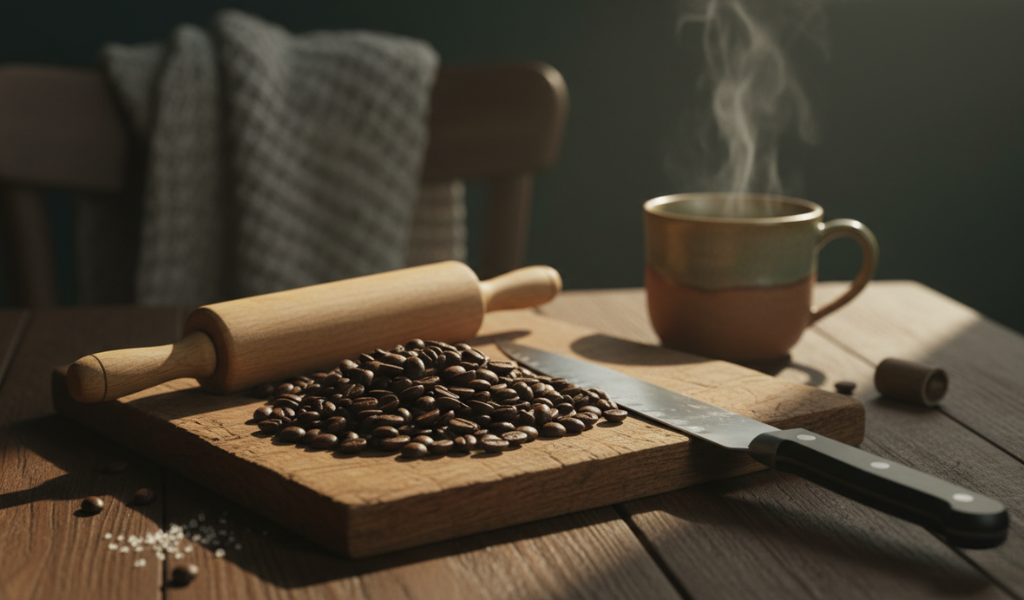
Whatever the reason, the panic is real. But don’t worry, you aren’t stuck with instant coffee just yet. Learning how to grind coffee beans without a grinder is a survival skill every caffeine lover needs.
Believe it or not, people were enjoying coffee long before electric burr grinders were a kitchen staple. With a little bit of “elbow grease” and some common household items, you can transform those whole beans into a delicious brew. In this guide, I’ll show you exactly how to grind coffee beans without a grinder using everything from a blender to a simple hammer.
The short answer is: absolutely. Can you grind coffee beans using random kitchen tools? Yes, but there is a catch.
The “grind” is arguably the most important part of the brewing process. When you use a professional grinder, it creates uniform particles. When you use a hammer or a blender, the particles are often uneven.
However, when you’re in a pinch, “perfection is the enemy” of progress. Whether you have dark roast coffee beans or a light Ethiopian blend, the goal is to break the beans down so that hot water can extract the flavor. As long as you can crack that outer shell and increase the surface area, you can make coffee.
If you have power but no grinder, the blender is your best friend. Many people ask, “can you grind coffee beans in a blender?” and the answer is a resounding yes. In fact, it’s the closest thing to a blade grinder you’ll find in your house.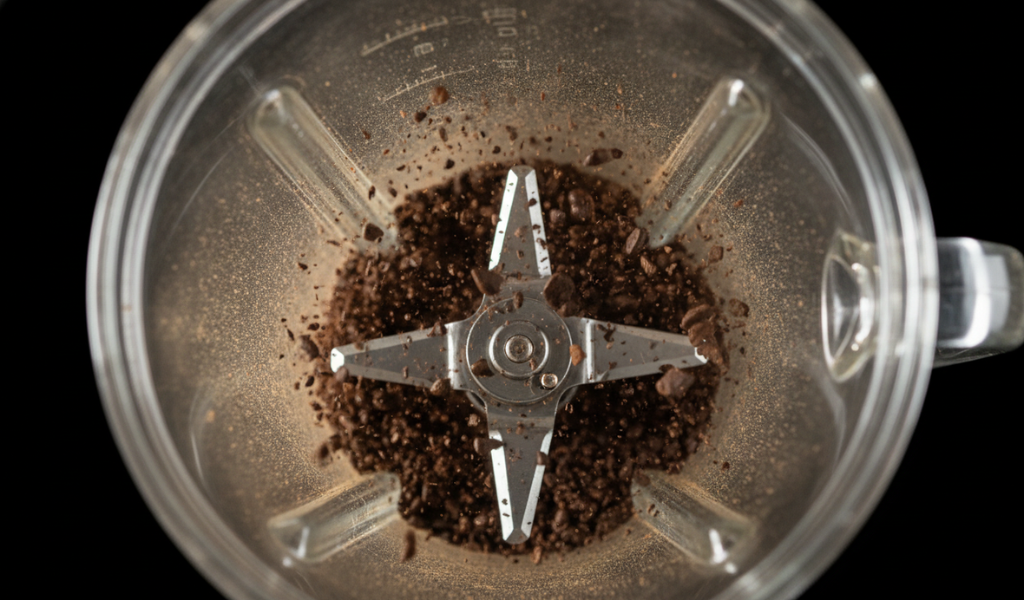
How to do it:
Small Batches: Only put about half a cup of beans in at a time. This ensures the blades hit everything evenly.
Use the Pulse Setting: Don’t just turn it on and walk away. You’ll end up with “coffee dust” at the bottom and whole beans at the top. Use short, 2-second bursts.
Shake it Up: Between pulses, give the blender a quick shake to redistribute the beans.
Aim for Medium-Coarse: Stop once the beans look like sea salt. This is perfect for drip coffee makers.
If the blender is busy or you don’t have one, a food processor is your next best bet. It works similarly, but because the bowl is wider, it’s actually better for creating a consistent coarse grind—perfect if you love a French Press.
Step-by-Step:
Pour in your coffee beans.
Pulse in short intervals (3 to 5 seconds).
Since the blades are further apart than a blender, you may need to tilt the processor slightly to ensure every bean gets caught.
This is a “crushing” method rather than a “cutting” method, which many experts believe preserves the natural oils of the coffee better.
Place your beans inside a heavy-duty plastic freezer bag. Squeeze out as much air as possible so the bag doesn’t pop.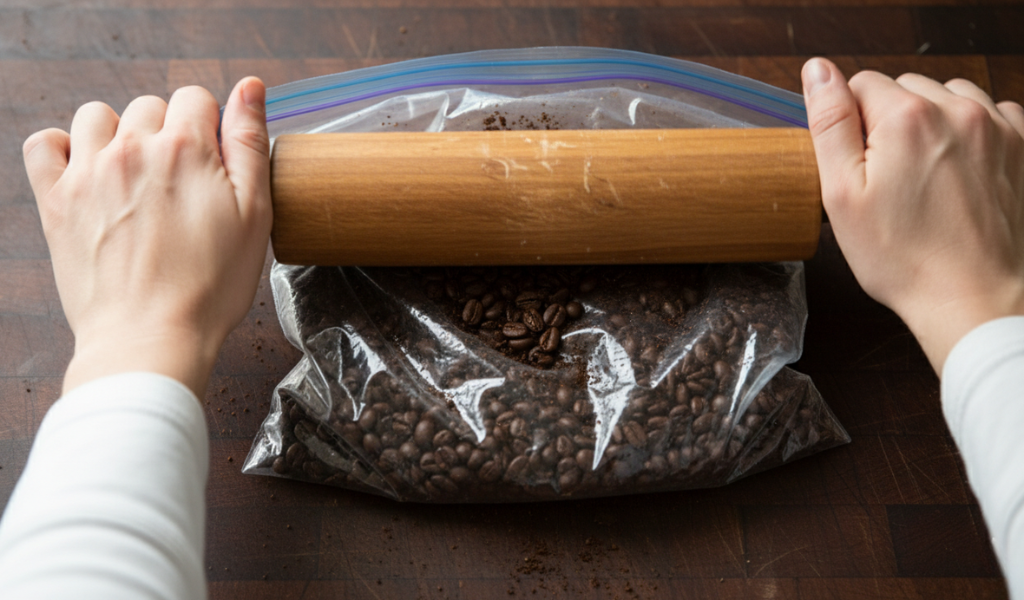
Lay the bag flat on a cutting board or counter.
Use the rolling pin like a steamroller. Start by pressing down hard to crack the beans.
Once cracked, roll back and forth with your weight behind it until you reach your desired consistency.
This is the most manual way to grind coffee beans, but it results in a very consistent texture because you are processing small amounts with high precision.
Consistency: You can actually achieve a very fine grind this way, suitable even for a Moka pot.
The Technique: Don’t just bash the beans. Use a circular “swirling” motion to crush them against the sides of the bowl.
Small Batches: Only do a tablespoon at a time. It’s a workout, but the aroma released is incredible.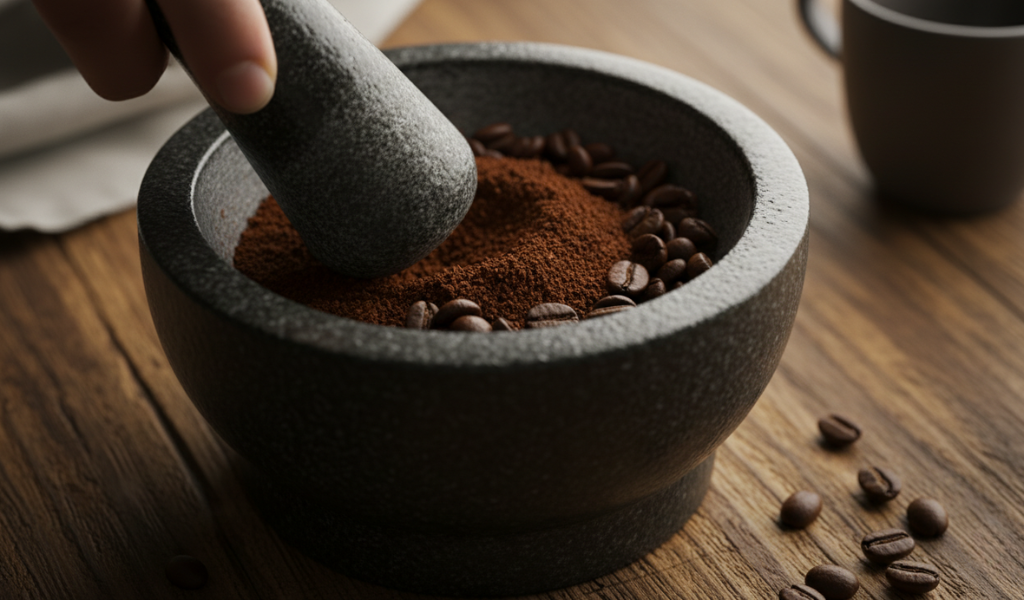
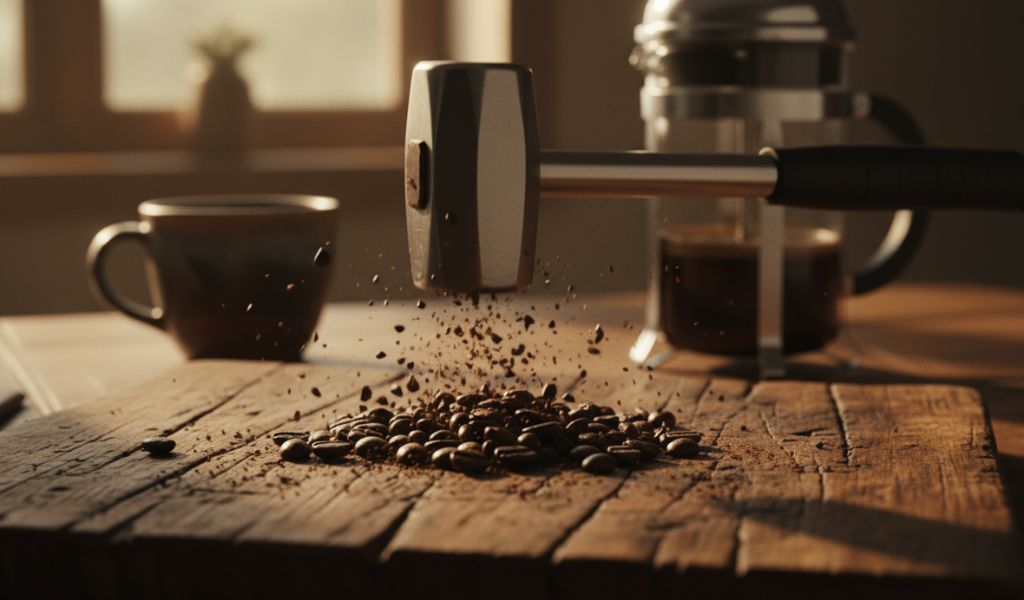
If you’ve had a rough morning and just need a cup of joe, the hammer method is surprisingly effective. It is essentially the “brute force” version of the rolling pin method. While it isn’t the most elegant, it gets the job done when you’re desperate for caffeine.
How to Execute the Hammer Strike:
The Container: Put the coffee beans in a sturdy plastic bag. If you have parchment paper or a clean kitchen towel, wrap the bag in that as well for extra protection.
The Strike: Gently tap the beans with the hammer. Do not swing like you’re driving a nail into a 2×4. The goal is to crack the beans, not pulverize them.
Consistent Movement: Move the hammer across the surface of the bag to ensure you aren’t just hitting the same spot.
Check Frequently: After every 10 or 12 taps, stop and shake the bag to bring larger chunks to the top.
This is the “MacGyver” of methods. If you are in a bare kitchen with nothing but a chef’s knife, you can still get the job done.
The Butcher’s Approach to Coffee:
The Setup: Use a large, flat chef’s knife and a heavy wooden cutting board. Avoid glass or marble boards as the beans will slide around too much.
The Crush: Place the flat side of the blade over a small pile of beans and press down firmly with your palm (like crushing a clove of garlic).
The Mince: Once the beans are broken, use a rocking motion with the knife—keeping the tip on the board—to mince the pieces.
Refinement: Continue chopping until the pieces look like coarse sand. Be careful not to let the beans “pop” off the board!
Note on Blender Heat: If you use a blender or food processor, let the motor rest. These appliances aren’t always designed for the resistance of hard beans.
Not all “hacked” grinds are created equal. Use this table to find your best match:
| Brew Method | Best Grind Type | Recommended “No-Grinder” Tool |
| French Press | Coarse | Food Processor or Rolling Pin |
| Drip Coffee | Medium | Blender or Hammer |
| Cold Brew | Very Coarse | Rolling Pin or Knife |
| Moka Pot | Fine | Mortar and Pestle |
Avoid using a blender for very fine espresso grinds (results will be uneven).
Do not use glass containers (they may break under pressure).
Avoid over-processing beans (can create a burnt taste).
Do not use dull knives (unsafe and ineffective).
When we step away from traditional appliances, safety becomes a priority.
Protect Your Counters: Never use a hammer or a heavy mortar and pestle directly on granite or marble. The vibration can cause fractures. Use a wooden cutting board or folded towel underneath.
Avoid Glass: Never try to crush beans inside a glass jar. The pressure required is more than enough to shatter glass.
Bag Integrity: Double-bag your beans when using the hammer or rolling pin method. If a bag pops, flying shards can be dangerous.
Knife Control: Keep your fingers tucked. Coffee beans are round and “skittish”; they can roll under the blade unexpectedly.
Now you know that a mechanical failure doesn’t have to mean a caffeine-free morning. Whether you decide to use the power of a blender, the precision of a mortar and pestle, or the raw force of a hammer, you can successfully grind coffee beans at home with ease.
The most important thing is to have fun with it! Coffee is an experience, and sometimes the best stories come from the mornings when things didn’t go as planned. So, grab those coffee beans, pick your tool of choice, and get to work. Your perfect cup is only a few “crushes” away!
1. Can you grind coffee beans in a blender without damaging the blades?
Yes. Coffee beans are hard, but they aren’t harder than ice. Just remember to pulse rather than run it continuously.
2. Is it better to use a blender or a food processor?
A blender is better for a finer, drip-style grind. A food processor is better for a coarse French Press grind due to the wider bowl.
3. How long does it take to grind coffee beans manually?
A rolling pin or hammer usually takes 3–5 minutes. A mortar and pestle might take 5–7 minutes for a finer consistency.
4. Will my coffee taste different?
It might be slightly “muddier” due to uneven particles. Using a paper filter will help keep your cup clean.
5. Can I use a meat tenderizer instead of a hammer?
Absolutely! Use the flat side for a more even crush.
6. Can you grind coffee beans for espresso without a grinder?
This is tough. Espresso requires a very fine powder. The mortar and pestle is your only hope here, but it takes significant effort.